

Food Notes: 1/13 - A History of Danish Butter Cookies
Butter cookies, Nutella, Gourmet magazine returns, and more!

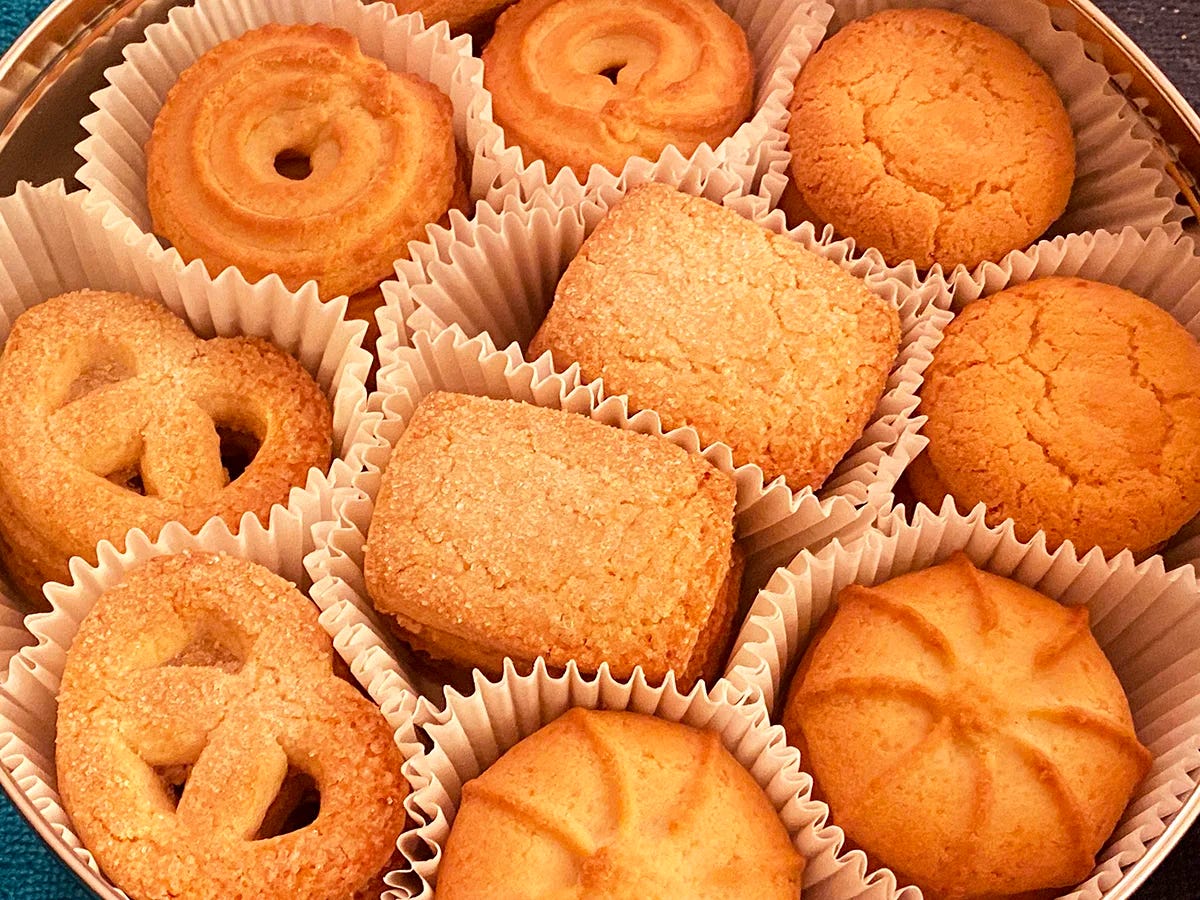
My wife wanted a sewing kit. So naturally I bought some cookies.
Even if you’ve never eaten them, you can probably picture the bright blue tin these Danish butter cookies are sold in. The Royal Dansk cookie tin is perhaps even more memorable than the cookies themselves, and most of us probably have one of those tins laying around the house filled with something other than buttery cookies.
The cookies aren’t bad. They are at least as good as my memory holds, though they are not especially memorable. Nevertheless, they show up every year during the holiday season like rum-soaked fruit cakes. So that got me thinking: who invented them, are they even Danish, and why does everyone have a blue tin?
I was disappointed to learn that unlike so many nostalgia treats, the Royal Dansk cookie tin isn’t attributed to a single creator. Instead, it was a product created by an industrial baker, with the intention of exporting the cookies around the world.
The Kjeldsen & Co Home Bakery was founded back in 1933 by Marinus and Anna Kjeldsen. Anna was the daughter of a baker, and the official Kjeldsens’s story claims she was known for her delicious cookies. The tasty cookies led the couple to start baking on an industrial scale. As early as the 1950s, Kjeldsens Butter Cookies were being exported to the United States, and in the 1960s, exported to Hong Kong.
Some people might recognize Kjeldsens Butter Cookies, which now also come in tins. But the famous blue tin came later. The line of Royal Dansk cookies was launched in 1966 and that same year the cookies began to show up in the United States with an ad describing them as “a true butter cookie from Denmark.” The original factory was based in Helsingør, today a northern suburb of Copenhagen.
A tin of Royal Dansk contains five shapes, and surprisingly each is slightly different. There is a darker “country style” cookie designed to be extra crispy. The Finish Bread cookie, a rectangular shape that is slightly sweeter with extra sugar. The ring shape is flavored with vanilla. The pretzel is meant to be crispier and flaky. And finally, the last circular shape has a coconut flavor, though I can’t say it has a strong flavor to it. As of 2023, the company was producing 25,000 tons of the cookies each year in two factories in Denmark.
The success of the butter cookie tin eventually led the founders to sell the family-owned business in 1970. The company then merged with another Danish bakery before selling to the Campbell Soup Company. Today, the Royal Dansk cookies are produced by Ferrero Spa, the Italian conglomerate behind iconic brands like Nutella.
The blue tins did help keep butter cookies fresh as they traveled to foreign ports. But they also helped make the brand part of everyone’s life as a storage device when the cookies were finished. Atlas Obscura had readers write in to discuss what people stored in them. Sewing supplies and buttons were some of the most common items stored in the tins, bits and bobs, and perhaps most surprising, an umbilical cord.
The Latest
Gourmet is back!
Condé Nasty shut down Gourmet magazine back in 2009, part of the many rounds of legacy media properties made unalive by corporate greed. Today, Gourmet relaunched as a newsletter, but there’s no corporate overlords looking down from the One World Trade. This venture is a wholly independent worker cooperative. As it turns out, someone in the legal department who’s probably about to be collecting unemployment later this week allowed the Trademark on Gourmet lapse back in 2021. That’s when a conglomerate led by journalist Sam Dean pooled some money to relaunch the storied brand.
The History of Nutella
Turin became a center of chocolate production until the Napoleonic wars created cacao shortages. That’s what local chocolate makers first started cutting chocolate with local hazelnuts, but it wasn’t until post-war Italy that spreadable hazelnut chocolate became a modern sensation. Over at Red Sauce America, I took a look at the history of Nutella, and how it helped grow an empire.
New York Pizza in the Year 2026
Pizza expert Scott Weiner sat down with Gambero Rosso to talk about the future of pizza in the city in 2026. He talks about the importance of social media, the rise of hot honey, Mayor Mamdani, and Neapolitan pies. Scott runs Scott’s Pizza Tours and knows more about pizza than anyone I’ve ever met.
Eat Your Wealth
Decorating food with precious metals like gold and silver is nothing new (although TikTok and social media has made it popular). At Taste, Anikah Shaokat looks into the history of eating gold and others precious metals, and why it can be dangerous when those metals are adulterated with less precious material.
Grass-Fed Beef for Climate Change? Not so Fast
Feeding grass to beef is better for climate gases by reducing overall carbon, or so advocates have claimed. That may not be the case, however, with some studies suggesting grass-fed beef causes more emissions. The bottom line is you should be eating in grass-fed beef because it tastes better.
The Ketchup Kangaroo Pouch
Heinz put out a press release about a new French fry package design that includes a little compartment for ketchup. It’s not even April 1! This is real!
The Bean Waitlist
The Rancho Gordo waitlist has hit 29,000 people. Steve Sando can’t keep up. The fiber and protein trends have driven people to seek out beans, but Sando only cares about flavor, and doesn’t want to market the nutritional benefits, according to the Wall Street Journal. What is a bean enthusiast supposed to do?