

Food Notes: 12/2 - A History of Spiral Cut Hams
Spiral ham, beans, Dr. Pepper, lychee martinis, cold-cut cookies, and more!

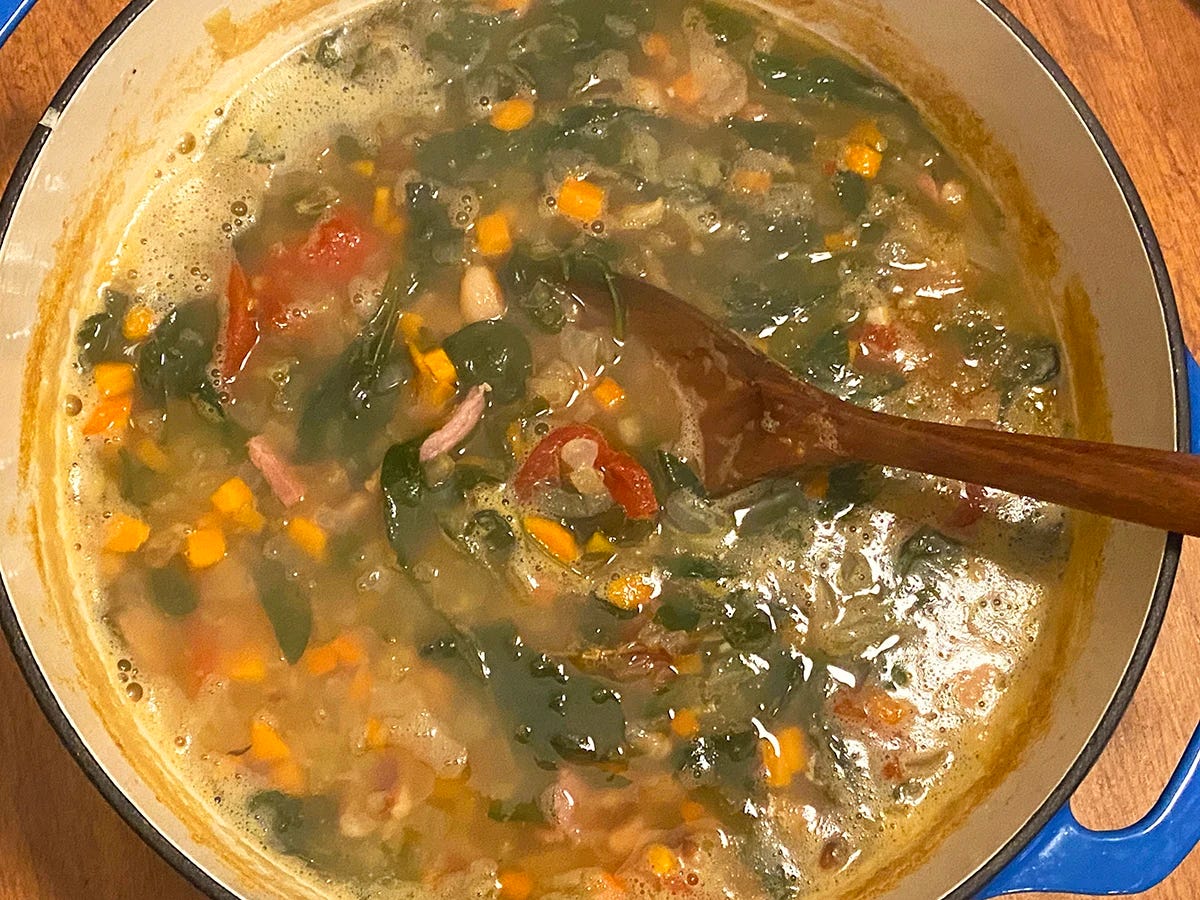
We had ham at Thanksgiving, so we turned it into ham soup.
If you’ve been following along, you’ll know our Thanksgiving dinner was reimagined this year, and we ended up with ham alongside roasted turkey. Spiral-cut ham isn’t an everyday occurrence. As a kid, the spiral ham was a specialty of my aunt who served it on Christmas Day (her specialties were spiral ham and Andes Candies, although not at the same time).
The spiral cut-ham is a modern miracle, perhaps the greatest thing since the invention of sliced bread. The first spiral ham was invented by Harry J. Hoenselaar, who claims to have dreamt up the device. The spiral slicer may not be a flux capacitor, but it was revolutionary. Today spiral hams make up about 1/3 of the ham market.
The process of making a spiral begins with a raw, bone-in ham — that’s the rear legs of a pig. Country hams are made by rubbing the meat with salt, spices, and then smoking it over wood and then left to hang dry for weeks. Spiral hams, on the other hand, use a slightly faster process, where the same cut is injected with brine, sugar, spices, curing agents, and briefly smoked before its ready for the slicing machine.
Hoenselaar built the first slicer in 1936, and 8 years later filed a patent. But the famous Honey Baked Ham Company wasn’t founded until 1957, when he opened the first store in Detroit. Eventually there were over 400 locations open year round selling the spiral sliced hams.
Today, many more manufacturers produce spiral sliced hams. There’s mass market versions at Costco, and bespoke crafted hams from heritage pigs, and of course you can still find the original spiral ham from Honey Baked.
With just five adults, there was plenty of leftover meat. For our first re-use, we made eggs with chunks of ham for breakfast, adding a bit of cheddar cheese. For the main event we decided to make ham soup.
The most recent bean club box had arrived from Rancho Gordo, and we pulled out a bag of yellow-eyed beans. My Google search pulled up this Ham and Bean Soup recipe from The Kitchn. I liked the way the photo looked and decided to cook up a soup that resembled that.
I recently realized that I often draw inspiration from good looking food photos. With the list of ingredients, I then try to replicate that visual image with an imagined flavor profile. Sometimes it works out, and sometimes it doesn’t. Don’t worry, it worked out this time.
It was a cold winter afternoon, dark at 4:15 in the evening, with a fire blazing in the fireplace. If all this sounds cozy, don’t be fooled, there was also a four-year-old jumping up around on the couch. When things finally settled down and a plate of dino nuggets was devoured, I served the soup with some crusty bread and Parmesan cheese.
Gourmet Bean Soup With Leftover Spiral Ham
INGREDIENTS
Half bag of Rancho Gordo Yellow Eyed Beans
1 large white onion
a few garlic cloves
3 stalks celery
2 carrots
A few slices of Leftover Spiral Ham
5 oz fresh baby spinach
1 small can of whole tomatoes
24 oz of chicken broth
Olive Oil
INSTRUCTIONS
Soak and cook your beans per the Rancho Gordo instructions
Finely dice the onion
Gently cook onions in olive oil
Slice garlic cloves; large, thin slices are fine if you plan on cooking the soup for a while, finely dice if you plan on rushing
Finely dice the celery and carrots; for a more rustic soup, keep the celery chunk and carrots as medallions (but the smaller diced pieces will make the flavor secondary to the beans, ham, and spinach)
Simmer vegetables
Remove tomatoes from can and slice into thirds
Toss the tomato liquid from the can, it’s lower quality and not necessary
Add tomatoes to the vegetables
Salt and pepper to taste
Pour in cooked beans with cooking liquid
Top off with chicken stock and bring to boil
Simmer and reduce by a quarter
Add spinach
Dice ham and add to soup
Simmer for several minutes while spinach wilts
Taste for salt and pepper
Serve with crusty bread
The Latest
Cold-cut Cookies
Check out this fanciful mortadella cookies. They aren’t actually made from meat, but they are meant to look like the Italian American sausage. There’s even a video from our favorite Claire Saffitz. The dish is inspired by chocolate sausage, like the salami made in northern Italy.
Dr. Pepper Is Back
Pepsi lost the cola wars, but there wasn’t to be peace in our time as long as Dr. Pepper lives! Turns out, Dr. Pepper is having a moment. There’s limited edition flavors like coconut, and a whole Mormon subculture where the sweet drink is added to cream to make a “dirty soda.” Careful if you google that because I’m sure a dirty soda is something else entirely in certain circles.
Produce, Now With More PFAS
If you haven’t been paying attention, the chemicals in your nonstick pans known as PFAS have been turning up everywhere in the human body. Turns out this class of chemicals cause cancer. (If you’re into movie dramatizations, check out Dark Waters, a lot like Erin Brockovich but with dead cows). Anyway, now farmers can spray the chemicals on some vegetable plants.
Yes Fleur de sel is Worth It
Cathy Erway looks into the traditions and history of Fleur Del Sel, and its something you’ll find far beyond France.
Return of the Fruity Martini
Francesca Giangiulio takes a look at the fruity, colorful drinks that are populating Instagram, where they come from, and why they’re suddenly back. From Lychee Martinis to Pink Cosmo, we’re headed back to the past. As an aside, I was in Chicago at a Red Sauce joint and the woman next to us was eating her first ever meatball. Like, she had never eaten a meatball before in her life. She then ordered a lychee martini, although the Italian waiter was very confused, took the request to the bar tender and then returned telling her they couldn’t make one.
Tis the Season for Atole
José Ralat explores the hot Mexican drink made from cooked corn, milk, fruits, and chiles. It’s more than a cozy holiday cocktail—sometimes its even used medicinally.
2025’s The Best of…
Our Favorite New Cookbooks of 2025, Bon Appétit
The 14 Best Cookbooks of 2025, New York Times
14 of our favorite cookbooks of the year, Washington Post
Best New Restaurants in America, Esquire
NYC’s Best New Restaurants, The Infatuation