

Food Notes: 2/24 - A history of chile cook offs
Chili, cook-offs, Olympic food, suitcase wine, French Onion soup, and more!

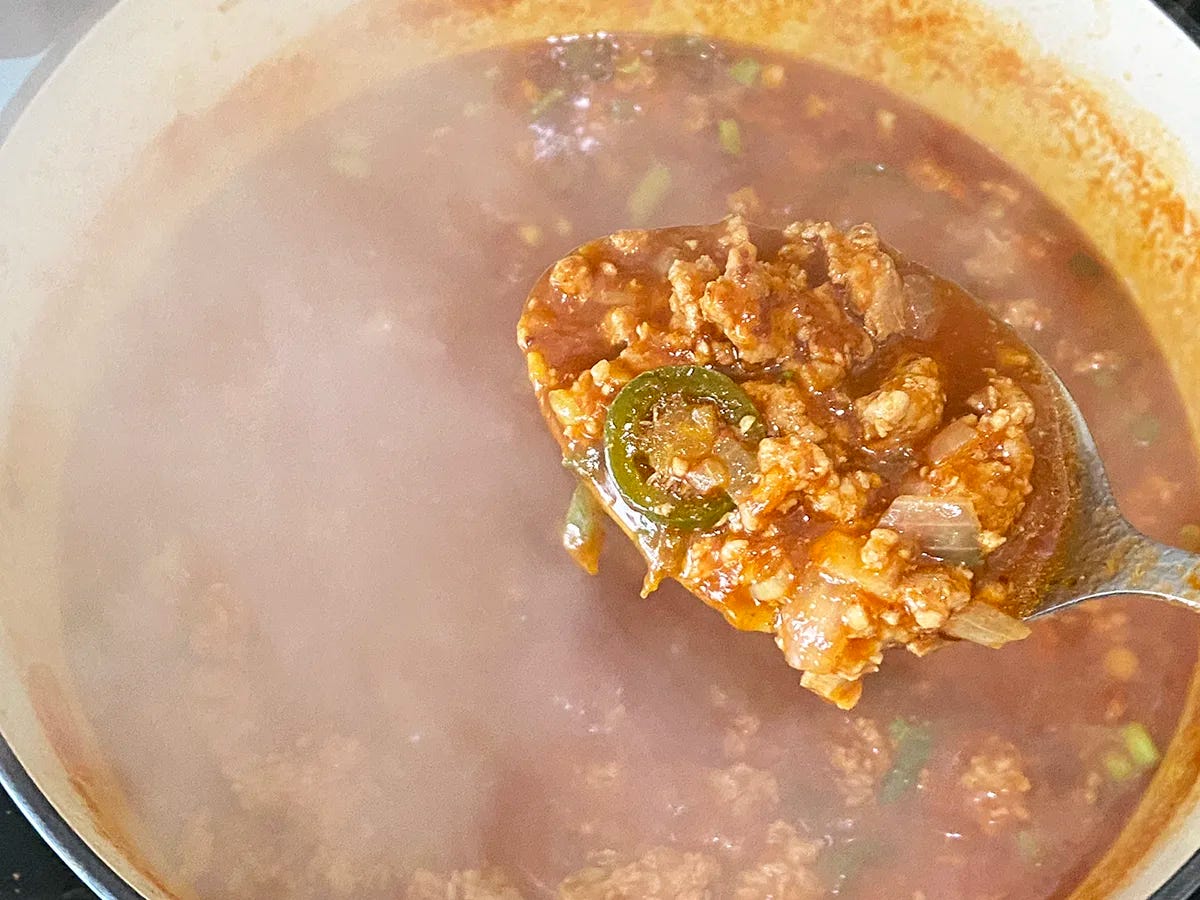
With NYC schools on a mid-winter break, we headed to southwest Florida where my in-laws could watch our four-year-old, so naturally we entered the local HOA’s chili cookoff contest.
The winter population of southwest Florida heavily skews towards retirees from the midwest who consider black pepper spicy and garlic some kind of ethnic food. Despite these limitations, I decided to cook up an Asian-inspired chili flavored with hot peppers and Chinese five spice.
The earliest cooking contests aren’t anything new. I’ve seen references to imperial cooks competing in ancient Rome and during the renaissance. One interesting contest dates to Medieval Iraq where the Caliphs, or local regional rulers, had a fondness for flavorful foods. In the 9th century, caliph al-Maʾmūn faced off against his brother, Muʿtaṣim, in what historian Nawal Nasrallah described as an “Iron Chef of Medieval Times.
Muʿtaṣim dish smelled delicious, at least until al-Maʾmūn’s cooking assistant Ibāda convinced Muʿtaṣim to add some additional ingredients, resulting in something unpleasant. Muʿtaṣim ended up with the last laugh however, when he became Caliph and exiled the assistant, Ibāda.
Chefs have long been the purview of kings and queens, and while these high level cooks have competed with each other to produce unique treats for their patrons, modern cooking competitions are more rooted in the pedestrian efforts of homecooks.
If you have ever wondered why The Great British Bake Off is retitled for broadcast in the United States as The Great British Baking Show, the reason is Pillsbury had already owned the trademark for “Bake-off.”
Pillsbury’s contests date back to the 20th century. To celebrate the company’s 80th anniversary, and promote its brand of flour, Pillsbury hosted the first Grand National Recipe and Baking Contest in 1949. The 100 semi-finalists were brought to the Waldorf Astoria hotel to prepare their recipe. The contest was eventually rechristened as a “bake-off” with themes, like the 1966 Busy Lady Bake-Off. The company trademarked the term in 1971.
The national competition had a big financial award, from $50,000 the first year to as high as million in later years, making it a significant milestone in cooking contests. The prizes and national stage helped supersize it, but baking contests, especially of pies, were long part of state fairs and 4H agricultural competitions.
In Colonial America, The Fredericksburg Agricultural Fair held in Virginia in 1738 is considered the oldest but the oldest state fair was held in Syracuse, New York in 1841. The shows highlighted new agricultural techniques, animal husbandry, and domestic cooking.
Food preparation contests grew in popularity by the 1920s when pies, breads, biscuits, and cookies were commonly awarded prizes. And perhaps, unsurprisingly, Pillsbury leaned into these contests to promote their flour. In a common newspaper ad published in 1925, a letter allegedly written by a Mrs. Ed P Carl extols the virtues of Pillsbury flour used in a fair’s winning recipes.
Chili cook-offs are obviously not the same as a pie contest (although the 2012 Texas State Fair did have the world’s largest Frito Pie made from 1,300 pounds of Fritos, chili and cheese). Looking back, the earliest reference to chili cooking dates t the 1920s, but these were for making chili sauce, not the chili con carne that has since become the state dish of Texas.
Chili cook-offs are relative newcomers in the food preparation category. Numerous sources have cited the 1967 Terlingua, Texas Chili Cook-Off as the first such contest. However, according to Texas Cooking, a Chili Cook-Off in 1952 pre-dates the contest in Teringua. This first cook-off was allegedly a promotional event cooked up by Joe E. Cooper, author of the With or Without Beans, an iconic history that explores the origins of chili.
Cooper died a few months later, but his obituary chronicled his ambitious search for the source of Texas chili. He spent months talking to people in Texas and piecing together the story. And thinking there might be something to find in Mexico, he crossed the border in search of answers. Once there, according to his obit, he finally found a restaurant willing to serve him chili – poured from a can manufactured in Texas.
Cooper’s contest featured 55 variations on Chili. Both the first place and second place winners had comparatively simple recipes, and neither included beans.
I was facing off against just 7 other competitors, including my mother-in-law.
The cook-off would be judged by everyone in attendance, about forty people who live in the homeowners association for the neighborhood (an association within a larger gated community). My wife and I were the youngest people in attendance, and almost certainly with a palette that preferred much spicier dishes.
I bought the Thai chilies anyway.
We had decided to replicate a recipe I had cooked up last year that had been based on a recipe for Vietnamese chili. I couldn’t find the recipe that inspired it, but my wife found a recipe to reference as a suggestion for spices. I didn’t even look it over.
At Whole Foods, we almost couldn’t find any Chinese Five Spice, only finding some hidden amongst a specialty spice rack. We also regretted not bringing some of our own Sichuan pepper, since apparently Whole Foods doesn’t stock it. But with Thai chilies and Serrano peppers, we certainly had enough heat to play with.
The cooking took about 90 minutes, and then it was showtime.
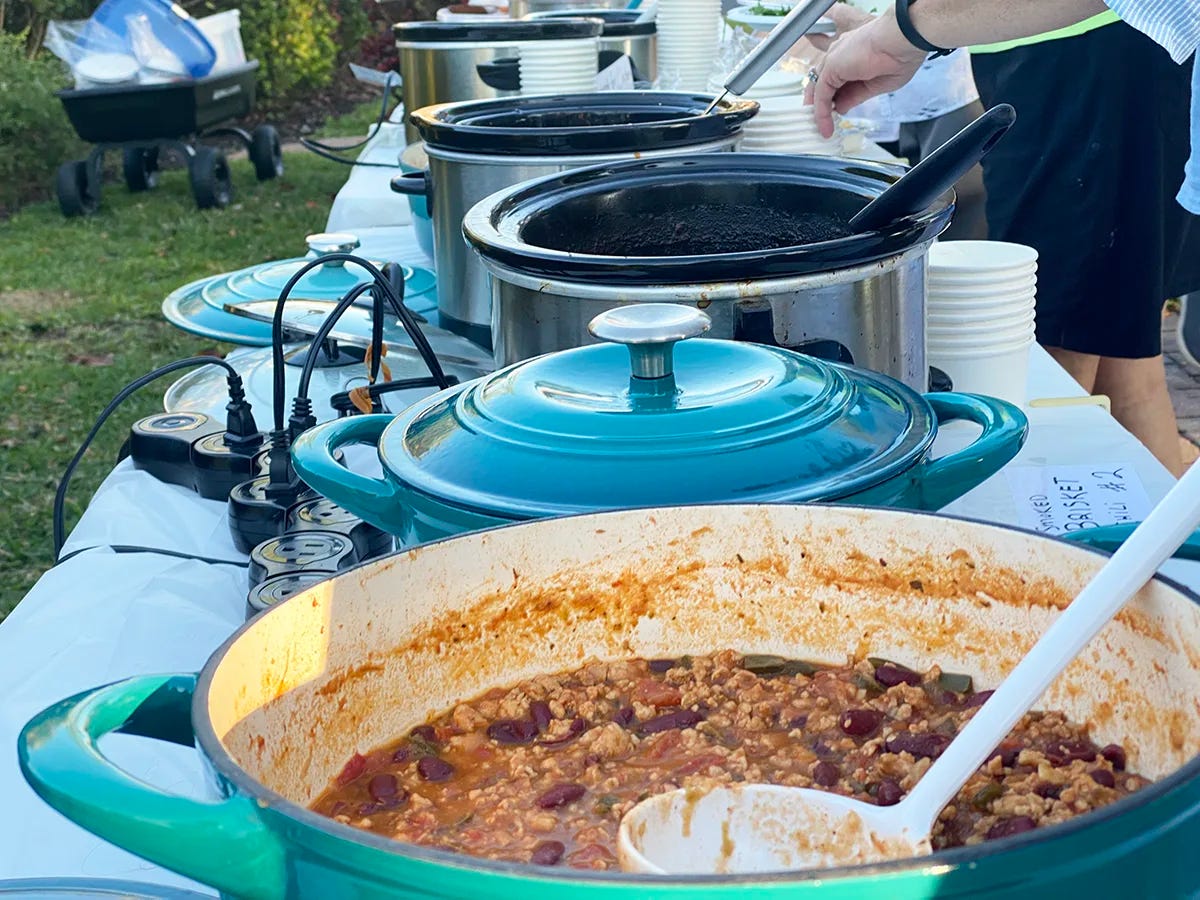
The event was held at a small parklet a few houses down from my in-laws. Two plastic flamingos guard the patch of grass. Golf carts lined the curb, and everyone had brought folding chairs arranged in a circle around an unlit fire pit. There were tables for cornbread and another for desserts. The eight pots of chili were lined up with numbered bowls. I sized up the competition.
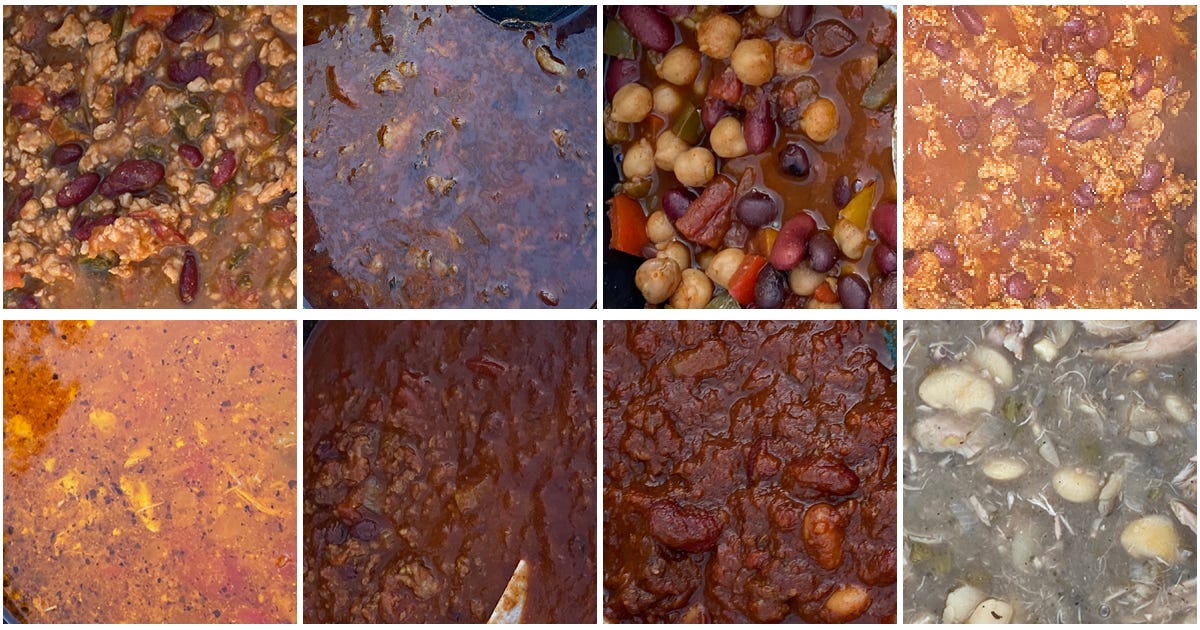
Most of the chilis included beans. One was made with chicken, and another with turkey, and yet another was made with a refrigerator. A few had accouterments like cheese – I offered chopped scallions to finish each bowl.
The crowd set to eating. I sampled each one, ate some cornbread, and then a few brownies. (Our four-year-old enjoyed a slice of cornbread, but otherwise abstained from chili).
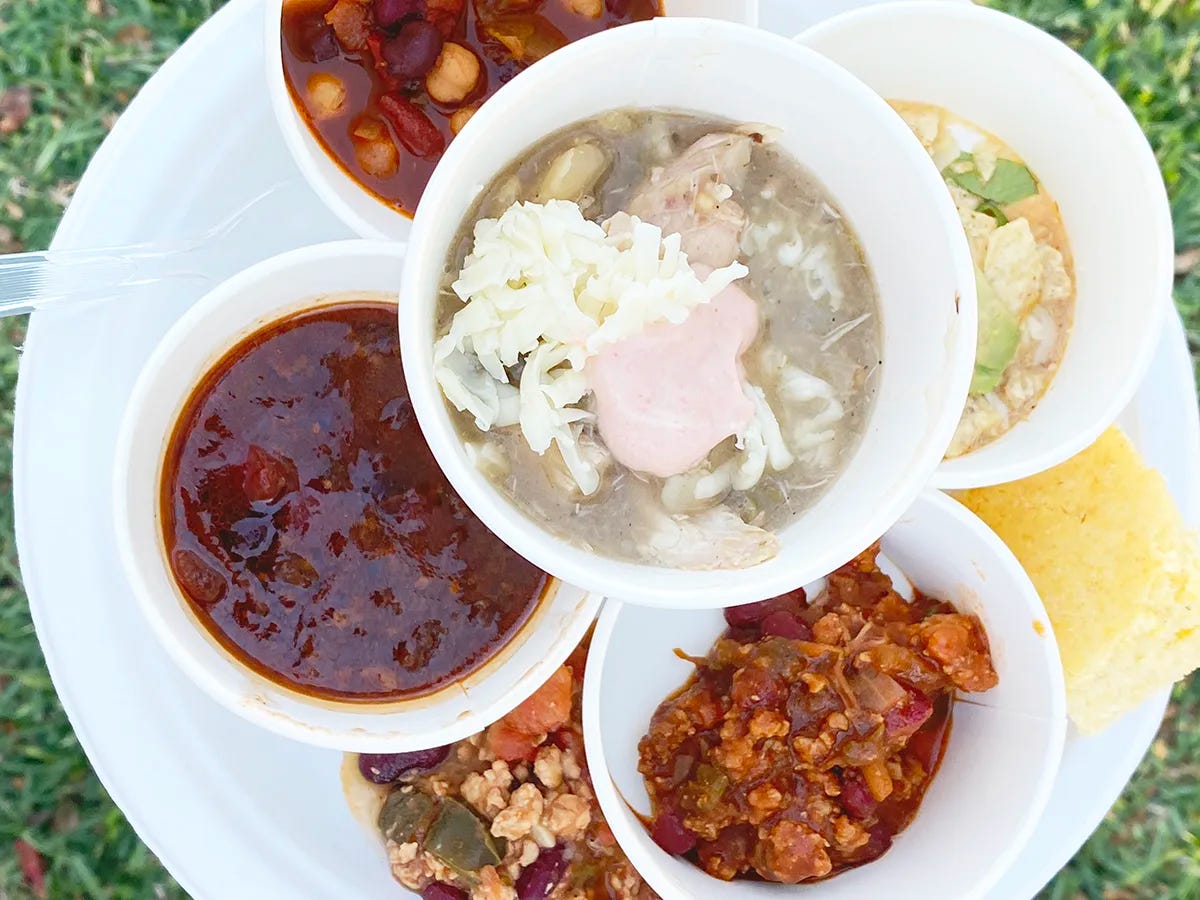
Each cup was marked with a number making it easy to keep track of which one we liked. I felt guilty voting for my own.
With the votes tallied, the winning chili went to a couple who had cooked up a rich beef brisket dish filled with umami flavor (top row, second column). There was no second place winner announced, but since my pot was the only one empty by the end of the night, I like to think I was the runner-up.
Porky Pacific Spice Cook-Off Chili Recipe
INGREDIENTS
1 onion
6 cloves garlic
1-2 tablespoon fresh ginger
5 Thai chilies
2 Serrano peppers
2 lbs ground pork
32 oz beef broth
6 oz tomato paste
1 teaspoon Chinese Five spice
1 teaspoon chili powder
1 teaspoon cumin
2 tablespoons mirin
2 tablespoons soy sauce
12 scallions
26 oz kidney beans
INSTRUCTIONS
Finely chop the onion, garlic, and ginger
Cook in olive oil until onions are translucent
Add finely diced Thai chili peppers
Cut Serrano’s into medallions and add
Push vegetables to side of pan and add pork
Brown the meat (add oil if necessary)
When meat is cooked through, deglaze with stock
Stir vegetables and meat together
Add tomato paste, stirring until combined
Add spices, including soy sauce
Stir and taste
Add dash of salt if necessary
Simmer until chili thickens
Drain beans
Add beans when chili is thick, but some liquid remains
Chop scallions and add half to the pot
Reserve the remaining scallions as garnish
Stir and taste (add salt if necessary)
Serve hot, garnishing with scallions
The Latest
Olympic-Sized Pizza
Athletes at the Winter Olympics in Milan consumed 2 wheels of Grana Padano cheese every day along with 800lbs of pasta and 12,000 slices of pizza.
Pecorino Romano, the Other White Cheese
Business Insider looks at the production of Pecorino Romano, an hard Italian sheep cheese. It’s saltier and not quite as expensive as Parmigiana, but often used as a substitute on pasta (at leaset in the United States). Meanwhile, much of the Pecorino Romano in the US is now under recall.
Does Popularity Make Rare Drinks Less Good?
Plenty of hard-to-find spirits have been making their way to the United States (at least, pre-tariff). But when those rarities arrive on our shores, do they suddenly not taste as good? Brad Thomas Parsons looks at “suitcase bottles” — those wines and liquors that are only available abroad — at least until they find an importer.
Has Enshittification Come For Reese’s? Probably.
The grandson of the man who invented Peanut Cups claims Hershey has started cutting corners which explains why the candy tastes bad.
Archestratus Set to Close
Brooklyn’s best cookbook store is set to close this spring as a slumping economy caused sales to take a hit while the wild and chaotic tariffs made many products more expensive.
Before Chips and Salsa
Chips and salsa are a pretty standard starter these days at Tex-Mex restaurants, often complimentary. But that wasn’t always the case. José Ralat looks back at some of the different little snacks handed out to restaurant patrons, including buttered tortillas and soda crackers.
French Onion Soup Is So Hot Right Now
Did Big French Onion Soup hire a PR firm? Everyone is writing about the beefy onion soup topped with bread and melty cheese: Serious Eats; Wall Street Journal; Food & Wine; Better Homes & Garden. If I was a conspiracy theorist, this would be more than enough to go down a rabbit hole.
Dumpling Lasagna
Jessica Wrubel experiments with making a lasagna from dumplings, just like all the kids on TikTok.