

Food Notes: 5/19 Frozen Concentrate Orange Juice
Orange juice, Johnny Appleseed, ketchup, pesticides in your berries, and much more.

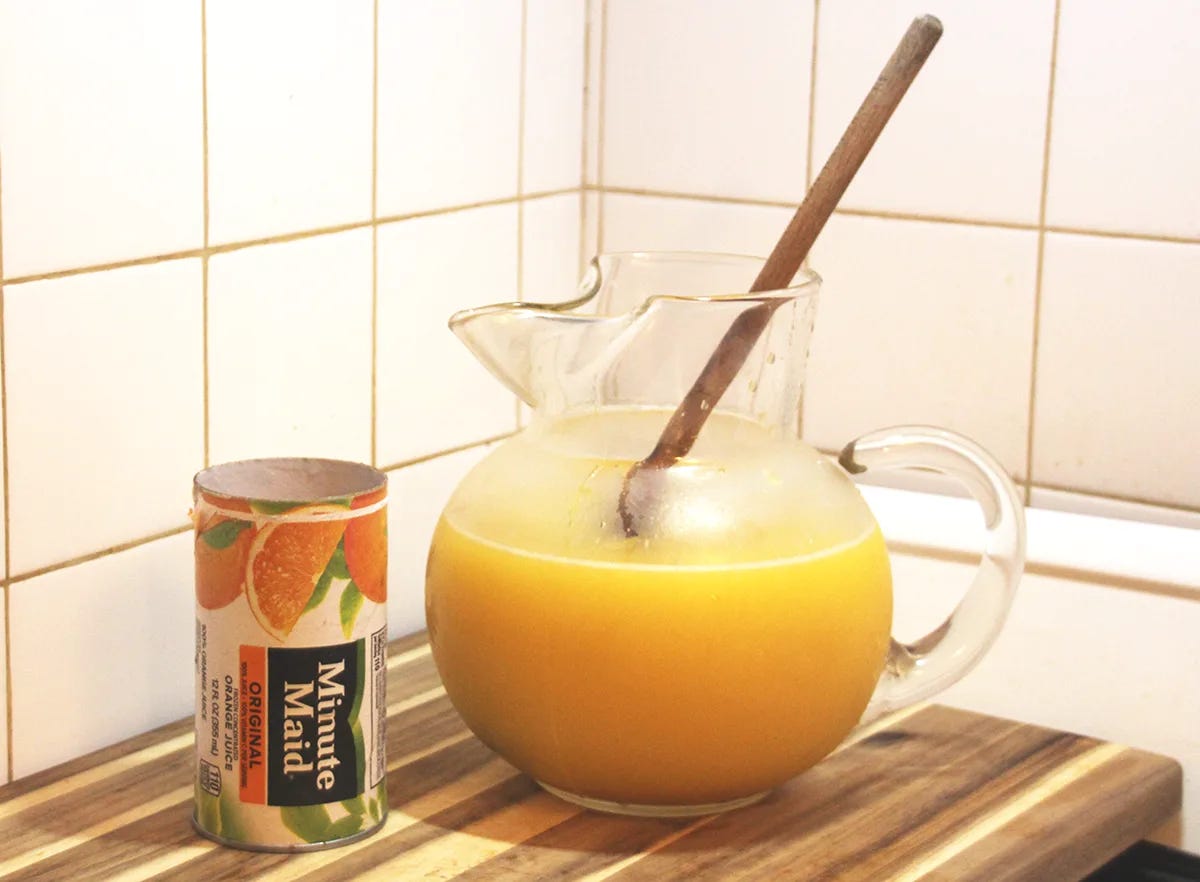
In February, Coca-Cola announced the end of Minute Maid brand frozen orange juice concentrate. Naturally, I went searching for a final can.
Minute Maid was first introduced in 1946 by Vacuum Foods Corp, a competitor to other frozen food companies like Bird’s Eye and Libby’s. The frozen orange juice concentrate was a breakfast-changing product segment.
Like so many good things, orange juice concentrate was actually an offshoot of a US military project designed to make vitamin C more palatable for soldiers. The goal was keeping the troops fighting in Europe healthy, and vitamin C pills just weren’t cutting it.
The frozen juice concentrate was good for farmers too. Oranges ripen and then rot, but juice means preserving the value of the delicate agriculture product. The frozen products were helped too by the suddenly wider availability of home freezers.
It’s easy to overlook how the home kitchen has evolved in the 20th century, and how that impacts the food products we have access to. Artificial electric refrigeration wasn’t universal until the post war era. In the 1930s, only around 8-10% of households had refrigerators, and by the start of World War II, that number increased to 44%. But by 1950, refrigerators were in close to 90% of households. Home freezers followed a similar trajectory beginning in the 1950s when only about 12% houses had them, but that quickly increased through the decade. Consumer goods followed the trend, with products like frozen meals and other convenience foods growing popular.
Convenience was the name of the game in the post-war period. Frozen, ready to eat meals, and juice that didn’t need to be squeezed out of the fruit. That’s why frozen concentrated orange juice was convenient. A can mixed with water in just a few minutes. Until then, making fresh orange juice required squeezing oranges, usually by hand, and that was assuming fresh oranges were even available. The seasonal crops could be transported around the country, but could still rot after they were picked.
Minute Maid changed all that.
The marketing in 1948 promised “Fresh, Pure Minute Maide” that was “quick frozen.” In an ad from Parents’ Magazine (July 1948), the copy explains the frozen concentrate costs less than the oranges “you’d have to lug home and squeeze.” This convenience angle was a big part of the appeal. Another ad in Good Housekeeping (January 1950) claims it was the equivalent of 9 to 12 oranges.
Sales increased fast. Minute Maid saw a 300% increase between 1948 and 1949, the equivalent of 735,000,000 cans of juice. And orange juice wasn’t the only product Minute Made had turned into a concentrate. There were other flavors like pink and yellow lemonade and limeade. These other flavors expanded the brand’s presence, but accomplished the same thing—turning delicate citrus crops into a stable product. All of these are being discontinued.
But in the middle of the century, the explosive demand for concentrate helped field the growth of the citrus groves in Florida.
Minute Maid’s main rival through most of its history has been Tropicana. The brand launched in 1947, but the challenge to Minute Maid’s concentrate came in 1954 when the company launched a “fresh” juice product. Italian immigrant Anthony T. Rossi delivered fresh juice locally around Manatee County, Florida. Rossi worked toward expanding his operation beyond local deliveries, and his breakthrough innovation came with pasteurizing the drink, and shipping it nationwide beginning in 1970.
Tropicana wasn’t just going after Minute Maid’s frozen cans that consumers mixed at home. Other juice brands were made from frozen concentrate, but full strength before packaging. As a commodity, the frozen concentrate could be bought and sold on futures markets while maintaining consistency.
By the 1970s, Tropicana was selling Americans on the idea that “not from concentrate” was intrinsically better and set itself apart from Minute Maid by pushing the “not from concentrate” tagline. The “Fresh-frozen” concentrate had lost its appeal with consumers.
The process that makes never-from-concentrate orange juice stable enough to ship around the country also removes most of the natural orange juice flavor. The juice has the flavor added back to it before bottled for consumers. The added benefit is a uniform flavor regardless of the source of oranges. And the source of oranges had begun to evolve too.
Orange juice became big business. Coca-Cola bought the Minute Made brand in 1960, adding juice to its portfolio of drinks. Pepsi eventually bought Tropicana (and has since sold it). But for a time, the superpowers behind the cola wars were also sparring in the juice aisle.
Oranges production has grown into a global business. Brazil, especially, has grown into a huge competitor to Florida’s citrus crops. The source of juice matters less when it’s either turned into a concentrate available as a commodity, or when it’s pasteurized and the flavor is curated by artificial means. Luckily we aren’t dependent on Florida today, since the state’s citrus crop is failing.
Florida’s orange crop in 2003-2004 hit 242 million boxes of 90lbs each (the record in 1997-1998 was 244 million), but has since been declining. This year, just 12 million boxes are projected.
Citrus is in trouble. Globally, but especially in Florida.
Florida’s housing boom a few years ago saw plenty of groves become rows of little boxes made of ticky tacky. The rough hurricane seasons haven’t helped. And of course, there is citrus greening disease. All of these factors are making oranges less local to Florida, and driving up the price of orange juice.
And maybe that’s just the reason the frozen concentrate from Minute Maid is going extinct.
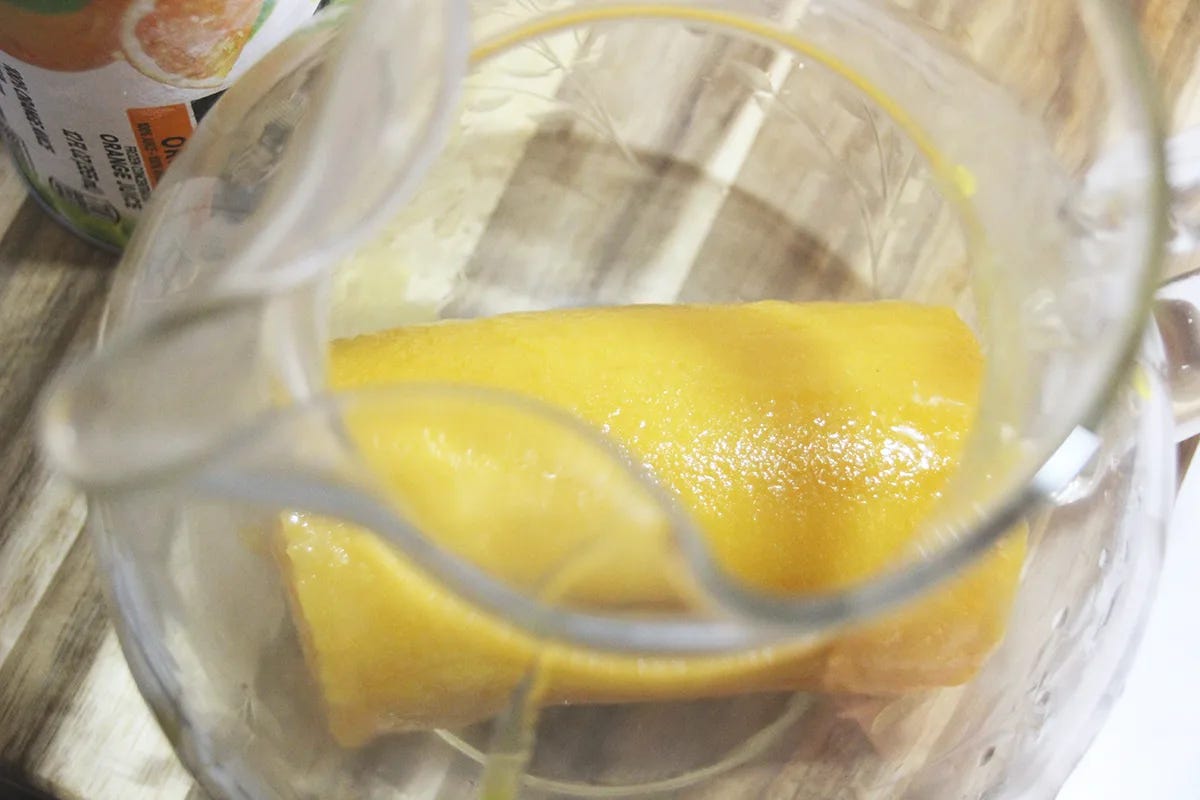
As a very young child I can remember drinking orange juice mixed up from the frozen log. But those freezer aisle staples, the black label canister, soon gave way to Tropicana’s white cartons with their promise that it was not from concentrate. Decades passed since I had mixed up orange juice, and I wanted to do it one last time.
My wife wasn’t sure what to make of my experiment. She too had frozen concentrate as a child, and then never again. It was a product from a different time. We tasted it unsure what to expect. It was good, better than I had expected. I would enjoy drinking this.
And then the reality hit me. The bulbous glass pitcher would need a home in the refrigerator. It was a quaint throwback to a different time, but inconvenient. And then there was the price. Once a budget friendly item, Minute Maid’s frozen cans have been creeping up in price, an increase of as much as 13% since last year. And that’s exactly what I thought most about. The can was almost $5, a price that seemed twice as much as it should have been. I enjoyed it, but did I enjoy that much?
Orange juice has become a luxury product. Ready to drink orange juice still costs more per serving, and as pleasant as it is to start the day off with a sugar rush, we’ve all come to realize fruit juice isn’t as healthy as we have been led to believe. It’s a treat, like candy.
Nevertheless, all this made me think of the childhood cocktail that was a favorite of mine, which I’ve graciously decided to share.
Lemon-Lime Orange Juice Spritz
INGREDIENTS
7 UP
Orange Juice
Bendy straw
Splash of artificial Maraschino cherry
INSTRUCTIONS
Combine equal parts of 7 UP and Orange Juice
Splash in some Maraschino cherry juice
Add ice cube and bendy straw
Garnish with as many cherries as you can get out of the jar before someone stops you
The Latest
Following the Trail of Johnny Appleseed
Folk legend Johnny Appleseed was an actual person, and he really did walk westward planting apple trees — more for making hard cider than for eating. More recently, Isaac Fitzgerald decided to take a walkabout following in Appleseed’s shoes, and wrote about it in his new book, American Rambler. I had the chance to talk with him about the adventure for the Chicago Review of Books.
AI Is Coming For Baristas, Just Not Yet
Andon Labs in Sweden launched a test cafe where the manager was an AI robot powered by Gemini, that annoying Google AI that is ruining your browser. Big surprise, Mona didn’t do a very good job managing the cafe. She ordered eggs despite not having a stove, 300 cans of tomatoes, despite nothing on the menu having tomatoes, and then didn’t bother order bread, 86ing the cafe’s sandwich menu.
Rabbit: Its What’s For Dinner
A new series of Clarkson’s Farm, the reality show featuring petrol-head-turned-gentleman-farmer Jeremy Clarkson, will be released in a few weeks. Publicity for the upcoming episodes includes Clarkson discussing a new addition to the farm: rabbits. High end restaurants have been importing the fury creates, unlucky feet and all, from France of all places. Can you imagine being forced to eat French rabbit? All this talk of rabbits has me recalling this delicious rabbit ragù I made during the pandemic when the grocery stores were pulling all their random meats out of the freezer.
PFAS In Your Berries? It’s More Likely Than You Think
Driscoll’s strawberries are coming up extra chemically with tests showing the fruits have pesticide residue, including PFAS, the compounds used in making pans nonstick and which have been linked to various cancers. Organic berries have come up clean.
Ketchup, Without the Plastic
For a limited time, Heinz is bringing back the iconic glass bottle. The limited run will only be available at Walmart celebrating its 157th Anniversary. Technically, the company still produces glass-bottled ketchup for the restaurant industry.
What the heck is an Heirloom Tomato?
Tomatoes move fast. New varieties are being invented all the time, usually selected for qualities like color and durability rather than flavor. So heirloom tomatoes have become all the rage—but even are they? Emily Saladino writing at Bon Appétit, takes a look how the differ from “regular” tomatoes.
Meat Factories To Move Faster
Limits on the speed of meat processing are about to be increased, which can lead to dangerous conditions for workers. And don’t forget, it’s not just workers at risk. Historically, bad meat processing practices aren’t great for consumers.
Gouging the Snack Size
Smaller bags of snacks are about to get more expensive as Pepsi raises prices on their brands. In this economy?
Yemeni Coffee Takes Over
Laila Ibrahim digs deep into the trendy middle eastern coffee houses popping up everywhere. These aren’t your stodgy Starbucks. where there aren’t chairs or bathrooms, but rather missing third spaces where people can hang out, drink coffee, eat sweets, play games, and exist as humans. ANd with Gen Z not drinking alcohol coffee houses make sense.