

Food Notes: 6/2 Spanakopita
Greek spinach pie, French cheese, strawberries, soup n burger, and more

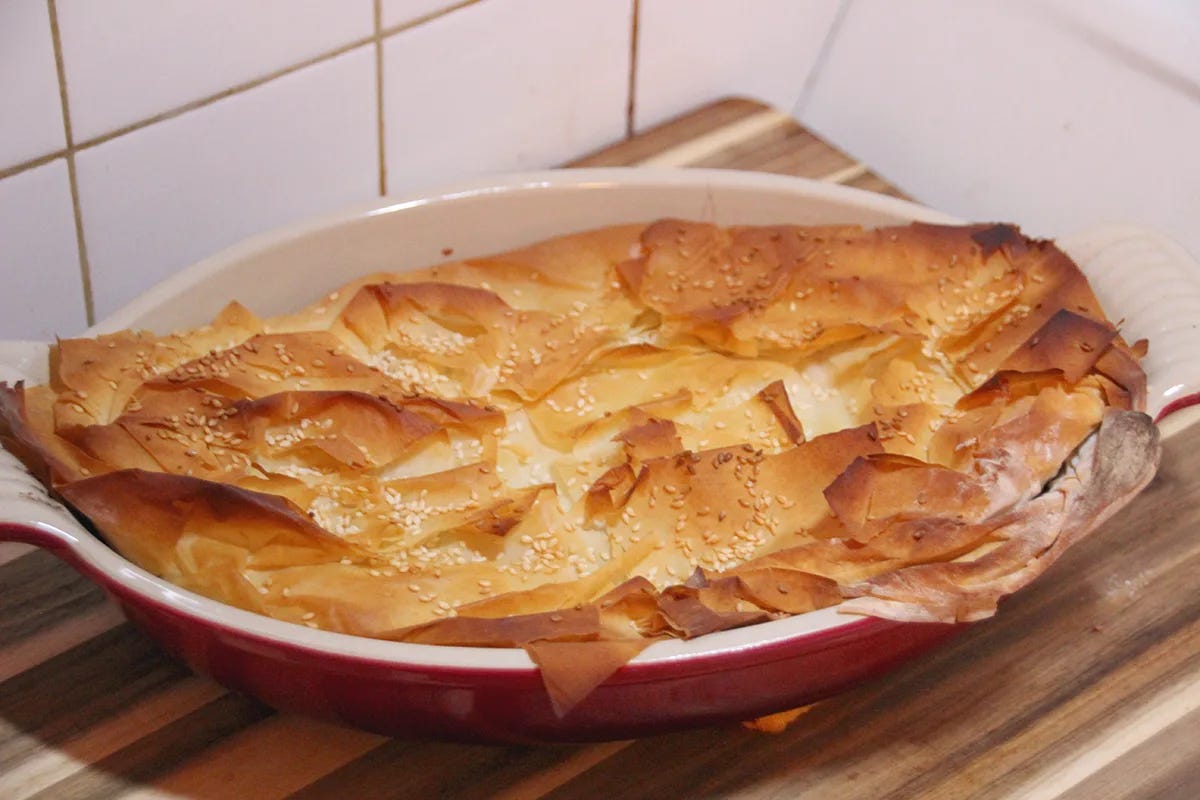
“Spanakopita! You hungry?!” ask Aunt Vuolo, immediately after telling the story of how the lump in the back of her neck was really her twin. Aunt Vuolo is perhaps better known for the line: “What do you mean he don’t eat no meat? That’s okay, I make lamb!” in the 2002 film, My Big Fat Greek Wedding. However, the lamb last week was $18 a pound, so I made spinach.
Spanakopita is the formal name for Greek spinach pie made with phyllo dough and feta cheese. This iconically Greek dish has its origins in the Medieval period when spinach arrived from the middle east by way of the Byzantine empire. Unsurprisingly, similar spinach pastry pies are found in Lebanese, Syrian, and Turkish cuisines and elsewhere the empire ruled over.
Phyllo dough, the delicate pastry, also has origins in the Byzantine Empire. The Byzantine Empire controlled portions of Turkey and Greece and the eastern Mediterranean (with some fluidity) for nearly 1200 years beginning in 306 CE. The empire, and the region it controlled, was largely the eastern remains of the declining Roman Empire, a fact worth remembering as we approach the 250th anniversary of the United States.
Today, it might seem as though Greek-style spinach pie is available in every diner along the east coast, but it wasn’t always that way. While spanakopita probably arrived with Greek immigrants, it wasn’t well known in the United States until the mid 20th century.
Greek immigrants arrived in the United States in large numbers at the end of the 19th century. Many took jobs washing dishes. By the 1930s, first generation immigrant restaurant owners were ready to sell on, and Greek immigrants were in the position to buy up the businesses they worked in.
In the post-war period, another surge of Greek immigrants began arriving, fueled in part by the disruptions in Europe of World War II and the Greek Civil war between 1946 and 1949. The resulting influx of Greeks led to many joining family members and friends already in the restaurant business, or using those networks to enter the industry themselves. That legacy remains evident in diners in the northeast and “house of pizza” restaurants in New England – and why spinach pie is often on the menu at all these places.
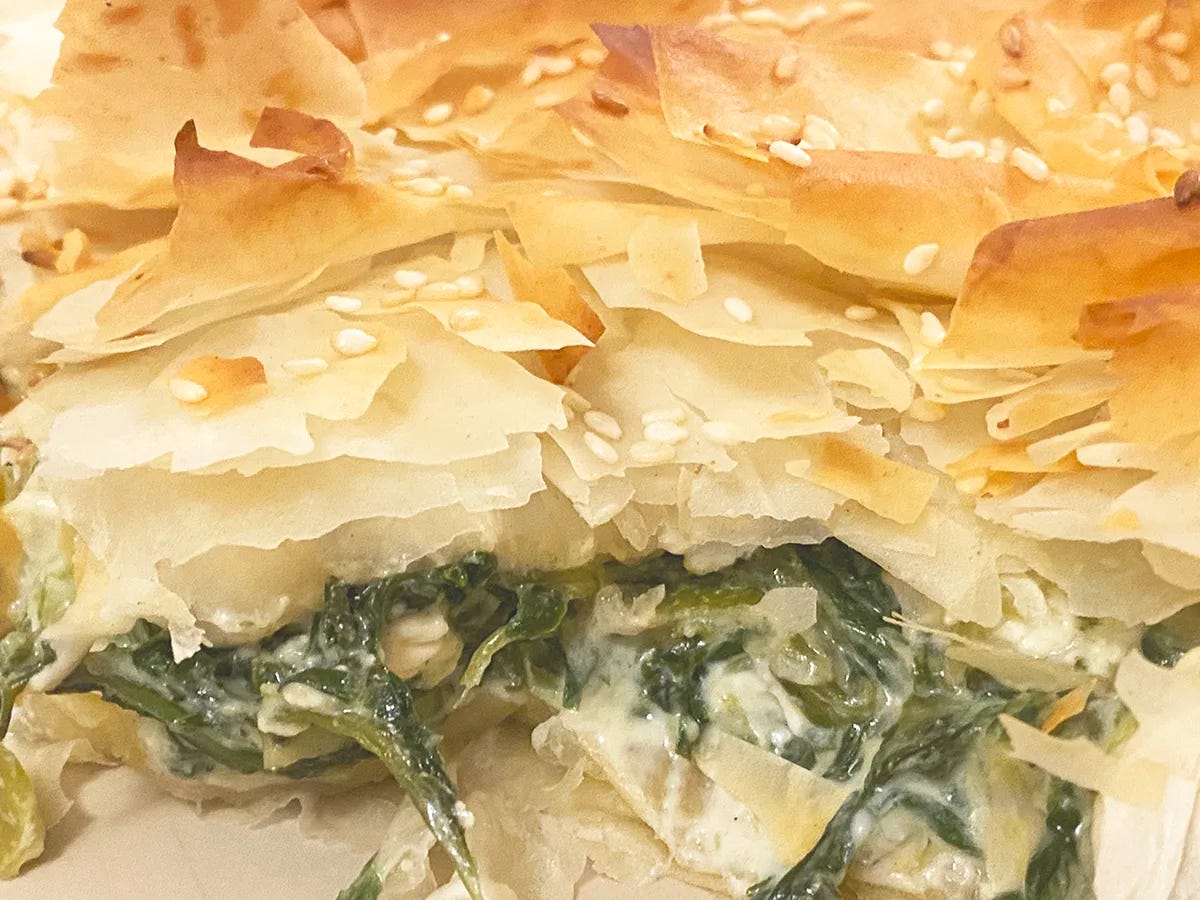
Spanakopita is widely available in the United States today, but that wasn’t always the case. Even in the 1950s and early 1960s, there are few references to the dish in American newspapers and magazines. That changes though by the middle of the decade.
In 1964, Woman’s Day put out a publication, The Collectors Cook Book: Greek Cookery with Spanakopita recipe featuring “filo” dough. The booklet helpfully includes a recipe for the dough, as well as numerous other Greek specialities like grape leaves.
From around 1965 onward, spanakopita recipes abound. Newspapers and magazines offer different methods, though many feature frozen spinach as the primary ingredient. Plenty of these recipes include cottage cheese in place of or in addition to feta. But the frequency of the appearance of the dish reflects the change in the way Greek cuisine was perceived among American consumers.
By the 1970s, restaurants featuring Greek cuisine (rather than simply having Greek owners operate a restaurant with an existing menu) were becoming more common. “Greek restaurants, plain and fancy, have been mushrooming in cities across the United States lately,” notes Tom Hoge, writing for the AP in 1973. He also includes a spanakopita recipe. The spinach pie offered an easy gateway to access the ethnic dish.
By the 1980s, spinach pie triangles became a popular appetizer. And the recipes promoting them no longer needed the pretense of an explanation. Readers knew these were Greek. They ceased to be exotic.
And that commonality is probably why when I did a quick internet search for spanakopita recipes while standing in the frozen food aisle looking for phyllo dough, I came across what seemed like an infinite number of variations.
I had never worked with phyllo dough, frozen or otherwise. I wasn’t sure what to expect, whether it would be more like sheets of puff pastry or the hard shells of a premade pie crust. I was surprised it was more like delicate sheets of paper.
As I typically do, I looked over a bunch of different recipes. I didn’t do a great job of keeping track of them. I felt a little bit like Rachel making English trifle, combining the best of multiple variations.
The main alteration that I made was I added in some ricotta cheese instead of cottage cheese. I make no claim about authenticity. I prefer ricotta’s sweetness over cottage cheese, and whether or not spanakopita should include cottage cheese at all was not an issue I was concerned with. I’ve had spinach pie where the filling is too dry, and the ricotta ensures it’s not. I also didn’t include an egg in the mixture because I prefer a softer filling and didn’t want it to get, as Prue Leith might say, stodgy.
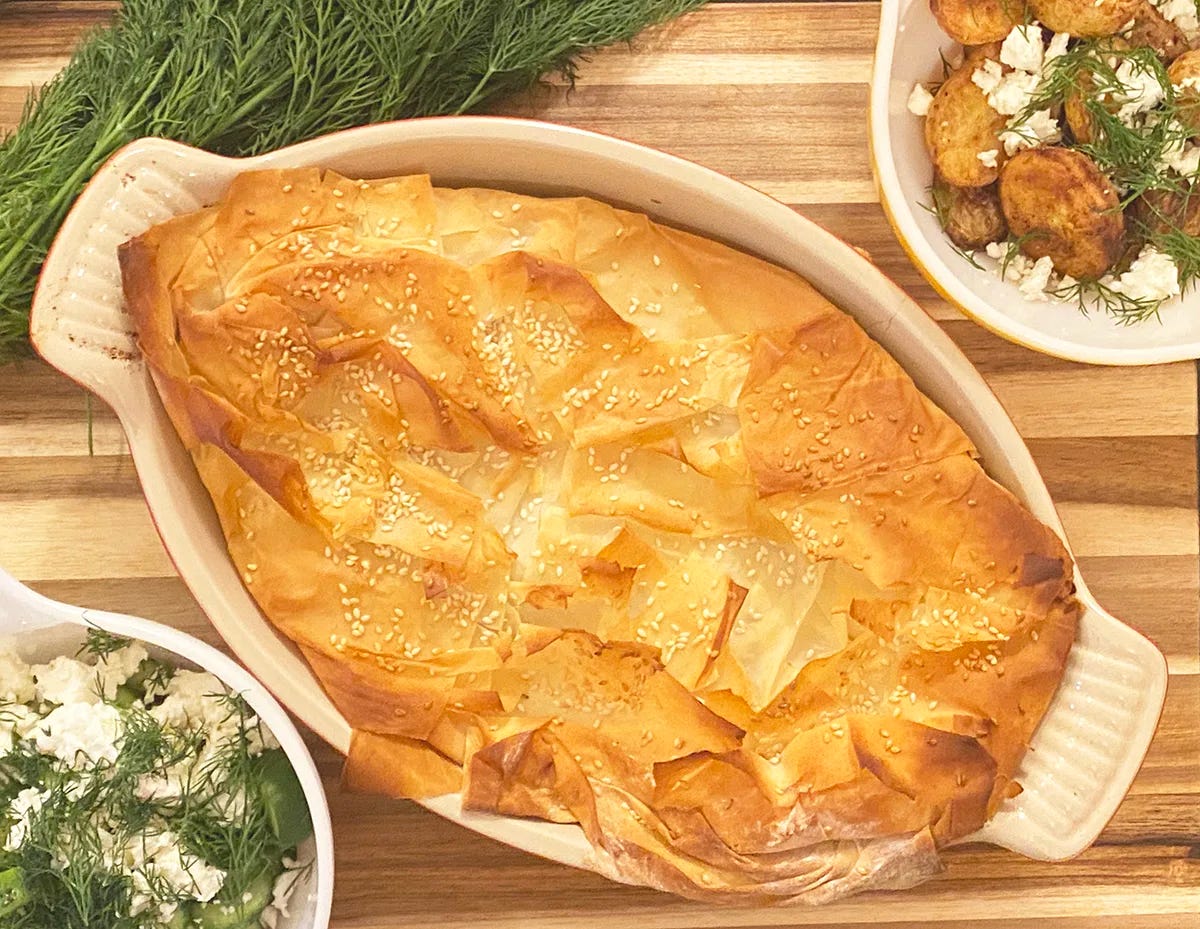
I baked it up and served it alongside Greek-style meatballs (pork, not lamb), potatoes with feta, a little cucumber and tomato salad, and tzatziki sauce that I made myself, swapping lime juice for lemon, since that’s what we had on hand
.
Spanakopita (Ian’s Version)
INGREDIENTS
2 bunches of fresh spinach
1 shallot
1 bunch of scallions, about 8
Two big scoops of ricotta cheese
6-ish ounces feta cheese
2 squirts of lemon juice, using the last of it so you run out before making tzatziki
1 bundle of frozen phyllo dough
Olive oil
Sesame seeds
INSTRUCTIONS
Defrost your frozen phyllo dough per the packet instructions (definitely read those instructions before you decide to start cooking, about 3 hours)
Finely chop the shallot
Begin cooking in a dash of olive oil
Wash and chop the spinach
Add the spinach to the shallots and slowly wilt
Cook on low medium heat to remove the water
Finely chop the scallions and add them to the spinach
Squirt in some lemon juice
Salt and and pepper to taste
Allow to cool
Break up the feta and add to the spinach mixture
Add in the ricotta and stir
Taste filling
Unroll your phyllo
Layer phyllo down in your baking pan (stoneware works best)
Hang the phyllo over the edge of the pan so that it can fold over
Between each layer, brush with olive oil
Fill the pie
Fold over the phyllo
Brush with olive oil and dust with sesame seeds
Bake at 350 F for 30 to 45 minutes; rotate in the oven if yours is uneven
The Latest
Influencers Cause French Cheese Shortage
Online influencers have gone gaga over Cancoillotte, an obscure French cheese product. Made from skim milk residue, and combined with butter, salt, and occasionally flavorings like onions, the cheese was known mostly only in the region around Franche-Comté, near the Swiss border. Then the protein bros and health fanatics discovered the gooey cheese and created a shortage.
El Nino’s Food Shortages
Turns out that having a very hot ocean isn’t great for food production. The super El Nino that’s predicted in the Pacific could lead to 10% to 50% increase in food prices.
The End of Soup N Burger
Jason Diamond wrote a love letter to Soup n Burger, which is set to close at the end of the month.
Tomato x 2
The latest issue of Alicia Kennedy’s Tomato Tomato is out.
Basketball Foods
If you haven’t heard, the Knicks have been doing really well this year. Thanks, Mamdani. The New York Post highlights all the blue and orange foods that are here to help you celebrate.
Strawberry Season
It’s that brief window in seasonal fruit when good tasting strawberries will become available. The delicate little fruits can’t ripen after they are picked, which is why good strawberries typically have a shelf life of a few hours, not that they last that long when I get them from the farmer’s market. Serious Eats has a guide to finding actual good tasting strawberries. Personally I’m hoping to pick a few straight out of the garden this weekend.