

Food Notes: 6/30 Oyster Po Boy
Oyster Loaf, Piadina, chicken cutlet, M&M colors, and more.

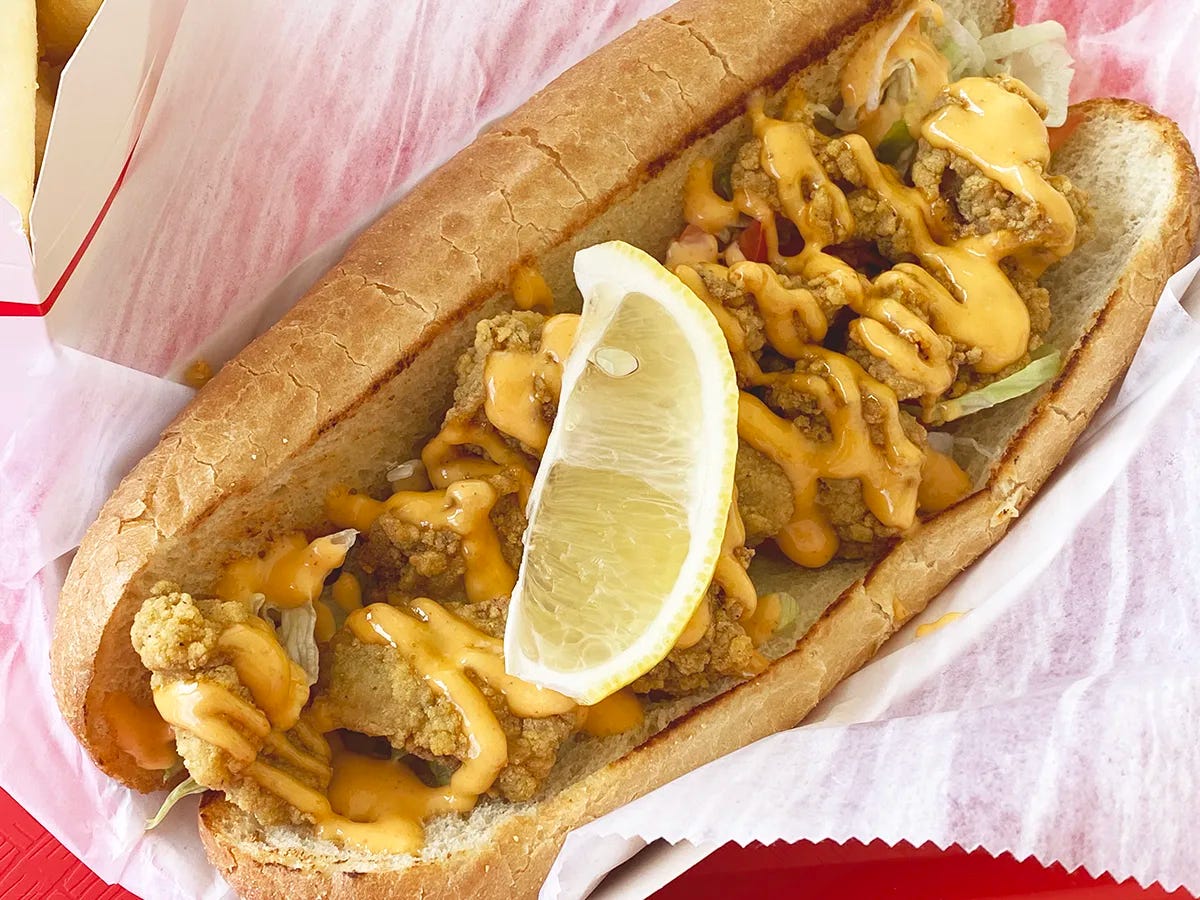
Summer has started. We’re out on Cape Cod, where seafood is everywhere. So naturally I ate a fried oyster po’ boy.
Fried oyster sandwiches seems like a natural fit for Cape Cod where oysters are plentiful and fried seafood a defining part of any summer vacation. And yet, the oyster po’ boy is a southern import.
Oysters have been part of the New England diet, more or less, as far back as humans have inhabited North America. Shellfish are everywhere, or they were before we mucked up the estuary waters where they grow. A combination of dirty water and over fishing cut the stock of shellfish along the East Coast in the early 20th century. Luckily, better water and better management have seen that trend reverse. Wellfleet oysters are a cherished commodity.
One reason for the over fishing, is by the 19th century, the greater Boston area was eating a lot of oysters. According to Dialynn Dwyer at Boston.com,
“In the late 1800s, The Boston Daily Globe printed a bewildering variety of oyster recipes, instructing readers to serve them baked, stewed, curried, scalloped, with quail, in an omelette, or — for the truly adventurous — in a pancake.”
Ironically, the oyster Po Boy was not among the list. Instead, Boston had bread filled with creamed oysters. Yummy.
The oyster loaf was direct ancestor of the oyster po boy, named so for its construction from a whole loaf of bread.
The oyster loaf also comes from Louisiana. Or San Francisco. Both cities might have a legitimate claim, according to William Peebles at Mobile Bay. This early sandwich involved a loaf of bread scooped out like an influencer’s bagel and filled with fried oysters. The sandwich was also nicknamed as a peace maker. The name comes from the calming effect it had on domestic life when a husband brought one home.
An account in a newspaper based in Missouri, in 1889, describes how to make an oyster loaf:
you take a small fresh loaf of bread; cut one end so as to make a hinge out of it; tear out the soft inside of the loaf with your hand; then butter the inside of the shell, using good butter and plenty of it; then stuff in a dozen fried oysters
The article attributes the bread to an San Francisco restauranteur who will serve it with pickles. However, there are earlier references to oyster loafs, like one from 1887 in the Daily Astorian in Oregon. While these citations are a good indication the oyster loaf was widely consumed, there’s more evidence this precursor to the Po Boy can be traced to New Orleans.
However, Mr. Peebles points to a 1878 church cookbook, Gulf City Cook Book, as having an oyster loaf recipe. James Karst at Times-Picayune found another reference to an oyster loaf as early as 1851. That would make the oyster loaf part of NOLA cuisine several years before it made it to the west coast.
The oyster loaf is a clear forefather to the poy boy. The sandwich known as the Peacemaker Po Boy combines fried oysters and pickles, much like the description of oyster loaf.
However, the original Po Boy has a distinctive origin in New Orleans, and it wasn’t always made with oysters. The legend describes the Po Boy as a product of sandwiches fed to the striking union workers. Bennie and Clovis Martin had opened a restaurant in the French Market. A few years later the city’s trolley operators went on strike. The Martins supported the working men by feeding them sandwiches.
The sandwiches were made from half a loaf of French Bread, and then loaded up with whatever items the hungry men wanted.
However, the term “poor boy” is derived from an ironic reference to the union workers, who were generally seen is better off than other laborers in town. But because of the strike they now taking handouts. As for the Martins, handing out free sandwiches was a great way to gain some free publicity.
Po Boys have come and gone and come back around again when it comes to trending foods. Po Boys trended a few years ago in Brooklyn in the 2000s and early 2010s with the fried chicken and barbecue joint trends. Catfish Po Boys were more common than oyster po boys. Ultimately the term Po Boy on a menu today comes with a description so you know what it has on it because the filling can vary.
Close to a century later, I was on the wharf in Wellfleet overlooking the harbor. The harbor pier has long had a seafood shanty perched on the edge of it. In more recent years, that shanty has been occupied by Mac’s on the Pier, part of a local chain of seafood markets and restaurants ranging from shanty to table service.
I’ve had plenty of po boys over the years stuffed with fish or inspired by bahn mi, or simply some kind of gentrified southern sandwich. But until this week, I’d never had an oyster po boy. I usually consume my oyster raw. The sanwich was altogether pleasant, and surprisingly light. I would order this again.
The Latest
Ode to the Chicken Cutlet
Everyone suddenly loves chicken cutlet. The fried chicken has become an Italian American staple. Rose Palazzolo over at Slate looks into why. And smartly, she chatted with me, since
The All-American Hot Dog
It’s almost time for the annual Coney Island Hot Dog Eating Contest, and so its the perfect time to look into the iconic food’s history. Over at Ravenous, Jaya Saxena looks into why hot dogs have become so iconically American.
Mozzarella Yarn Art
Check out this mozzarella stick made from yarn.
Are Piadina “The Sandwich of Summer?”
The New York Times has discovered Piadini, and Italian flatbread we’ve been enjoying since 2012 when Testo first opened. My wife even said: I wonder if they know about Testo? as she opened the article. And of course, the author finds his way there in the third paragraph.
Catching up With Ketchup
Some food trends come and go, but Heinz Ketchup has stuck around for 150 years. The key, it seems, was using ripe tomatoes. Plus a great marketing campaign.
Barbecue Week
Bon Appetit has a whole spread on barbecue this week — and not just the cookout kind of barbecue. There’s a look at Kansas City Style, Carolina sauce, Central Texas, and New American. This seems like a great time to point out I’ve been chronicling barbecue in New York City over at the sister-blog, All The Things I Eat.
Bye, Bye Blue and Brown
The two M&M colors are going away thanks to the efforts of RFK, Jr. to ban some food dyes. But hey, we’re still spraying Teflon directly onto food crops now, so we’re definitely going to be healthier.