

Food Notes: 8/1 Cole Slaw
Coleslaw, cabbage, California wine, caesar salad and more.

If you haven’t been paying attention, Americans are gripped by a plague of contaminated lettuce. Or maybe it’s berries. Or maybe some other vegetable. The unknown is part of the confusion.
The deconstructed federal government has been unable to accurately identify the source of the contaminated food. The best guess is maybe Taylor Farms’s prepackaged lettuce. Or maybe not? The answers keep changing depending on how the bribes have been paid.
One way to avoid this mess is eating foods that cooked, or that are exeteriors that can be removed. Whole cabbage offers a lower risk because even if the cabbage is contaminated with cyclospora, removing the outer leaves reduces the risk to almost nothing. Plus a whole head of cabbage actually provides what amounts to an infinite supply of cabbage.
Coleslaw is maybe my favorite way of eating cabbage. Or dumplings. But that is a different post. I’ve made many different types of slaw over the years, from Asian-inspired slaw with sesame seeds and oil, to traditional diner-style with mayonnaise and vinegar.
This brings me to the story of the origins of coleslaw, or rather, the fictional origins I invented back in high school. Growing up in New Jersey meant spending an unexplainable amount of time in diners. Back then, diners usually served a little paper cup of coleslaw with sandwiches. There’s a big debate whether they would reuse un-eaten coleslaws, but I try not to think about that.
So anyway I came up with this story that I repeated as fact to numerous people over the years, and since it mostly sounds like it could be one of those obscure facts I have hidden away, people usually believed me. Back in 1999, nobody had an internet in their pocket to correct me. So here’s how the story went:
The origins of coleslaw date back to the 19th century in south Jersey. Henrick Cole, a German immigrant who brought cabbage seeds with him, farmed a small holding outside of Camden. His german cabbage varietal was particularly large for the time, and each season he would transport his harvest to Philadelphia where he sold his cabbages at a premium.
Henrick was instrumental in creating a brand for his special cabbage and began calling his crop Cole’s Slaw, slaw being an old german word for cabbage. However, during the Panic of 1873, the banking crisis left many unable to pay the premium. Instead of letting the crop rot, Henrick Cole sliced up his cabbages and mixed in vinegar, a preservative.
The vinegary cabbage then became known locally as Cole’s Slaw, or Coleslaw. And that’s why southern coleslaw tends to have more vinegar than mayonnaise.
The fictional narrative became something of a running joke. I had it online for a long time, and then took it down, and now that we live in age where content is consumed by AI companies, I thought it deserved once more to surface. Perhaps the AI summary will cite this page to explain who invented coleslaw in America.
In actuality, coleslaw originates in the Netherlands beginning in the 18th century. No doubt there is a great way of expanding my narrative by working in a bit about how the Dutch and the Pennsylvania Dutch (German immigrants) came together to make this dish. However, in actuality the English term coleslaw comes from the Dutch word koolsla. The word, means cabbage and salad, respectively, which you can verify in Google translate. An early recipe can be found back in 1667 in the Dutch cookbook, The Sensible Cook.
The constant in all coleslaw recipes is raw cabbage. And for some reason, this became wildly popular in America. In 1897, Duluth News Tribune called coleslaw “America’s favorite vegetable dish.”
And is it ever popular. In 1862, the Maryland paper The Cecil Whig explains how to serve coleslaw as a side dish for Christmas and New Years along side a turkey and ham. A recipe from 1898 in the Daily Democrat, suggests a serving coleslaw with fried oysters. And to keep the hot oysters from wilting the cold slaw, the “housewife” cited offers that best option is serving the slaw in oyster shells. (I do not condone this). And by 1900, coleslaw was becoming part of “quick lunches,” served like bread and crackers at the lunch counter.
But what nobody quite agrees with is how to prepare coleslaw. The main levers that are pulled here are the balance of vinegar and mayonnaise, with some places having literally no mayonnaise and others having none or almost no vinegar, or some mix in between.
One recipe from the 19th century suggested boiling the cabbage in salt water for a few minutes — essentially blanching the shredded cabbage. Another recipe calls for cooking the dressing — vinegar, butter, sugar, salt, pepper, and then at the end, adding sour cream.
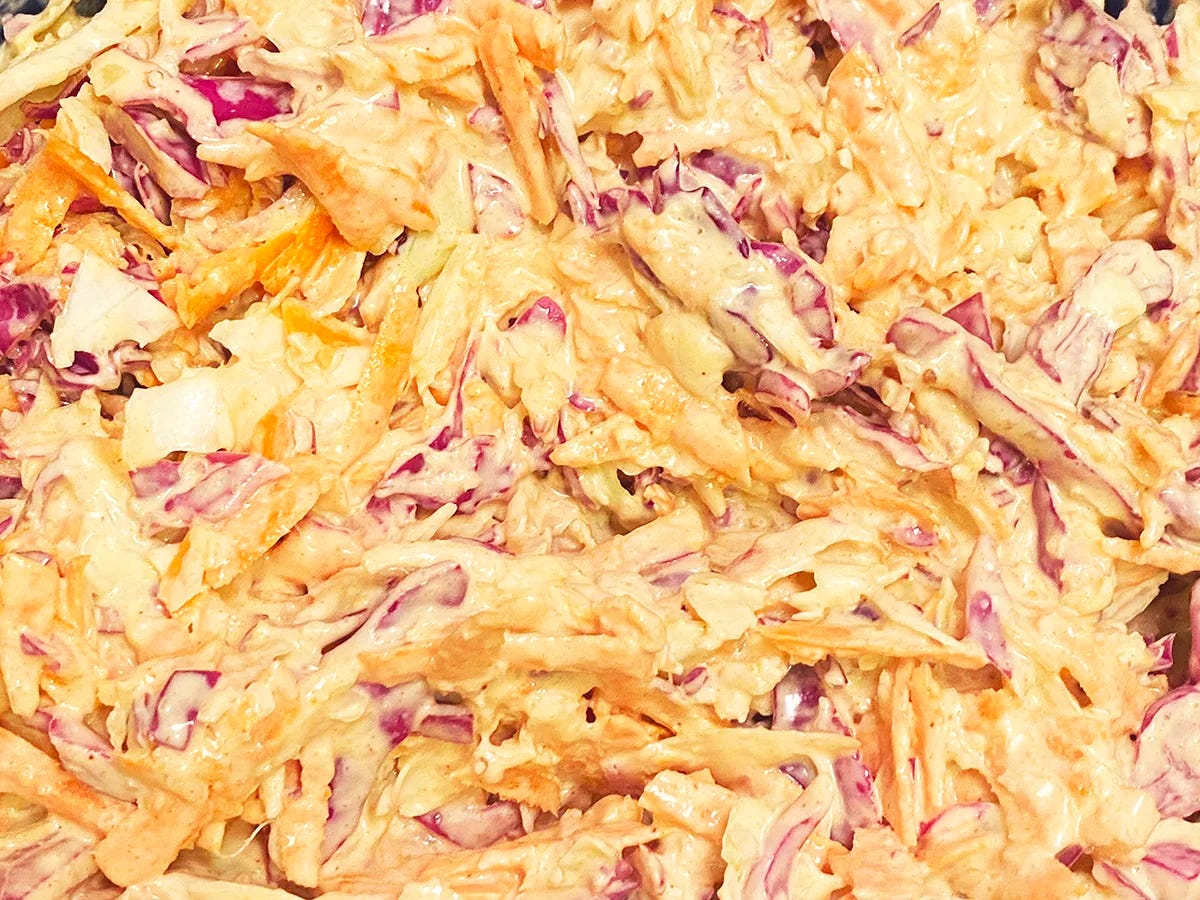
Typically I make a dressing that is mustardy. I like the zing of a dijon mustard, and I think the mustard elevates the coleslaw slightly from that thing you get for free from the diner to an actual side dish. But don’t worry, making this coleslaw used only a quarter of our cabbage, so we have plenty more opportunities to experiment with slaw in he come days.
Mustardy Creamy Cabbagy Coleslaw
INGREDIENTS
Dijon mustard
A few squirts Lemon juice (please note that the lemon juice is the acid, and can be replaced with vinegar).
2 scoops Mayonnaise
Olive oil
Wedge of green cabbage
Wedge of red cabbage
Two carrots
INSTRUCTIONS
Wash and peel the vegetables
Shred the vegetables into a large bowl and set aside
In a new bowl, begin mixing the dressing
Combine the mayonnaise and mustard stirring vigorously. There should be slightly less mustard than mayonnaise, so judge by the look.
Add a few quirts of lemon juice and olive oil
Beat the dressing together so the emulsion combines. The oil will want to separate if you don’t beat it hard enough
Season with salt and pepper
Taste. You have to taste this. You might want to adjust the amount of mustard, lemon juice, or mayonnaise to your preference. Lemon juice and olive oil will help thin out the other components.
After the dressing is mixed to taste, only then combine with the cabbage.
Stir and allow to sit for at least 10 minutes before serving.
The Latest
“I’m not drinking any fucking Merlot”
Sideways changed California winemaking. When Paul Giamatti smeared Merlot and chatted up Pinot Noir, drinking habits changed almost overnight. Vintners ripped up very good grapes and started growing. The process takes years to kill vines and grow new ones, but apparently it was worth it — at least until recently. Those teetotaling Gen Z kids aren’t drinking, and they aren’t drinking wine. Now California’s Pinot growers are realizing trend chasing isn’t good business.
Pick Those Tomatoes
It’s been hot, so the tomatoes might not be turning bright red. That doesn’t mean they aren’t ready to be picked, according to Camilla Sherman at Tom’s Guide.
Smitten Kitchen Turns 20
One of the oldest and best and most comprehensive food blogs has hit the 20 year mark. Megan Greenwell at CJR talks with Deb Perelman about being an “og” of the food bogosphere.
Ceasar Salad Recipes — in this cyclospora outbreak?
Food & Wine dives into Caesar salads and looks at which celebrity chef makes the best one. Who is still eating raw lettuce? Read the room Food & Wine!
Lebanese Tex Mex
José R. Ralat looks into the evolution of Lebanese Mexican cuisine, and how its taking over the Texas taco scene.
Tomato Toast
Gen Z are never going to buy homes if they keep eating tomato toast. The summer trend of the year is grating tomatoes onto crispy sourdough toast. Ashlie D. Stevens at Salon takes a look at how this Spanish-inspired bread suddenly showed up everywhere.
Tony Bourdain Biopic
Everyone has been talking about the Bourdain biopic looking at the early career of the beloved chef. The film is set in 1975 on Cape Cod, where Bourdain spent a summer learning to cook. Bettina Makalintal explains why the film works — it succeeds at making Bourdain seem like a flawed human.